
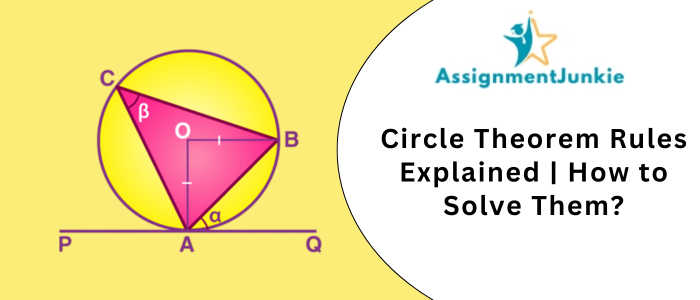
Although geometry can be exciting, the circle theorem is one of the most difficult concepts for many students in the UK. These theorems, which are essential for tests such as GCSE and A-Level, describe the relationship between angle, tangent, chords and Arcs in a circle. However, many students ask themselves, "How will I do my homework on it?" When faced with complex planning. Assignment Junkie offers the ideal assistance in this situation. You may comprehend and use the circle theorem principles step-by-step with professional assistance. Assignment Junkie guarantees that you will handle difficulties accurately and confidently, regardless of whether you need a trustworthy homework Specialist or would rather use expert help through do my homework services.
What Are Circle Theorems?
A series of mathematical concepts referred to as circle theorems describes the special features of angles, chords, tangents, and arcs within a circle. As per our “do my homework” experts, to answer geometry problems, especially for UK school examinations such as GCSEs and A-levels, these theorems are very important. They help students understand circular shapes' rationale, compute missing angles, and prove geometric relationships. One of the theorems, for example, reads that the centre angle is always twice as much as the diameter of the arc.
Nevertheless, a lot of students find it challenging to follow these guidelines during test situations, and they frequently conclude, "I wish someone could just do my homework for me." Assignment Junkie can help make learning easier in this situation. You may better understand these theorems and develop your problem-solving skills with the help of a qualified homework helper or reputable do my homework services.
Essential Circle Theorem Rules Every Student Must Know!
The foundation of geometry problems in UK exams is circle theorems, and mastering them may mean the difference between a mediocre and a stellar result. These guidelines aid in your comprehension of the exact relationships that exist between chords, radii, tangents, and angles inside a circle. Despite their seeming simplicity, they might be difficult to use while addressing problems, which makes many students assume, "I need someone to do my homework and explain this step by step." Let's examine the most crucial circle theorem guidelines you need to be aware of:
Angle at the Centre Theorem
A circle's central angle is always twice as large as the arc's circumference angle.
For instance, shared by homework helpers, the angle in the centre will be 80° if the angle at the perimeter is 40°.
Angle in a Semicircle
Any angle that a diameter forms at its circumference is always 90°, or a right angle. Despite being straightforward, this theorem is frequently applied in tests.
Angles in the Same Segment
Two or more angles are equal if they are produced from the same chord at the circumference. When a single figure has several angles, this rule is very helpful.
Cyclic Quadrilaterals
The opposing angles of a quadrilateral drawn within a circle with all four vertices touching the circle's perimeter add up to 180°. If you are facing any issues in comprehending your assignment prompt, consult our “do my assignment” specialists.
Tangent and Radius Rule
At the point of contact, a tangent drawn to a circle is always 90° perpendicular to the radius.
Alternate Segment Theorem
The angle formed in the circle's alternative segment equals the angle formed by a tangent and a chord.
You may answer practically any circle-related geometry issue by becoming proficient in these fundamental concepts. Assignment Junkie is here to help if you're still having trouble. Their knowledgeable staff can do my homework assignments accurately, and a committed homework helper makes sure you not only get the right answers but also understand the reasoning behind each step. Applying these circle theorems becomes simpler and easier with expert assistance, particularly while taking tests.
How to Solve Circle Theorem Problems Step by Step?
It is necessary to comprehend the rules and apply them correctly to solve circle theorem difficulties. When faced with a complicated diagram, many students in the UK become anxious; yet, it is often simpler to tackle the problem in smaller phases. This tutorial will assist you in approaching the issues methodically if you've ever thought, "I need someone to do my homework because circle theorems are too confusing."
Step 1: Carefully Read the Question
Determine what the inquiry is requesting first. Do you have to establish a connection, locate a missing angle, or justify the equality of two angles? Thorough reading helps you avoid casual errors. Get instant assistance by “do my assignment” services to perform better in your academics.
Step 2: Study the Diagram
The majority of circle theorem problems include a diagram. Take note of where chords, tangents, radii, or cyclic quadrilaterals are placed. Make a detailed note of the information provided. Make your own diagram if one isn't given; it will help you better see the issue.
Step 3: Identify the Applicable Theorem
One or more circle theorems are at the center of each question. Consider this:
- Is there a circumferential angle and a central angle? The Angle at the Centre theorem should be applied.
- Does a diameter at the circumference produce an angle? Apply the rule of "Angle in a Semicircle."
- Does the circle have four points that make up a quadrilateral? Use the theorem of the Cyclic Quadrilateral.
Half the answer lies in identifying the right theorem. Do my homework experts from Assignment Junkie can clarify how to connect theorems to problems if you're still unclear.
Step 4: Apply the Rule Step by Step
As you apply the theory, explicitly record each step. Don't exclude explanations; UK examiners value reasoning as much as the final response. For instance, shared by do my homework service:
- "Angles in the same segment are equal; angle ABC = 40°."
Step 5: Solve for the Unknown
To compute missing numbers, apply circle theorems, algebra, and fundamental angle characteristics (such as angles on a straight line = 180°). Verify your calculations again since even little mistakes might have unintended consequences.
Step 6: Check Your Answer
Lastly, go over the question again and make sure your response makes sense given the diagram's context. Many students receive worse grades when they provide incomplete answers or neglect to write units (such as ° for angles).
At first, circle theorem issues can seem insurmountable, but with practice, they become doable. Don't worry if you're still having trouble; Assignment Junkie is here to help. You may turn in your assignments on time and learn how to solve problems at the same time by using their professional do my homework service. In addition to receiving precise answers, working with a skilled homework Writer can provide you with the knowledge and abilities to handle related test difficulties on your own.
Master Circle Theorems with Expert Guidance from Assignment Junkie
Circle theorems may prove to be difficult to comprehend, particularly how to use several rules in intricate geometry questions. Most students find it hard to recognise which rule to apply, how to organise their solutions, and how to provide concise reasoning in assignment or test questions. This is where Assignment Junkie is here to become your trusted source.
If you’ve ever thought, “Can someone do my homework and make these theorems simpler?” then Assignment Junkie is the perfect platform for you. Our expert tutors and academic professionals specialise in breaking down circle theorems into easy-to-follow steps. Whether it’s explaining why the angle in a semicircle is always a right angle, or solving advanced cyclic quadrilateral problems, our Homework Writer approach ensures clarity and confidence in every solution.
By choosing Assignment Junkie, you don’t just get answers—you gain access to personalised learning, detailed step-by-step explanations, and accurate solutions that strengthen your problem-solving skills. From quick homework assistance to full assignment support, our service is designed to help you excel in mathematics without the stress.
So, the next time you’re stuck on a geometry task and wonder, “Who can do my homework on circle theorems?” remember that Assignment Junkie is here to provide professional guidance and reliable solutions.

Mitchell
Mitchell is a seasoned Ph.D. scholar with extensive expertise gained through years of rigorous research, publication, and teaching experience. He brings a wealth of knowledge and analytical skills to tackle complex academic challenges. His work is dedicated to delivering innovative solutions, advancing knowledge, and promoting academic excellence. Proficient in research methodology, data analysis, and scholarly writing, Mitchell has contributed to peer-reviewed journals and mentored students to achieve academic success.